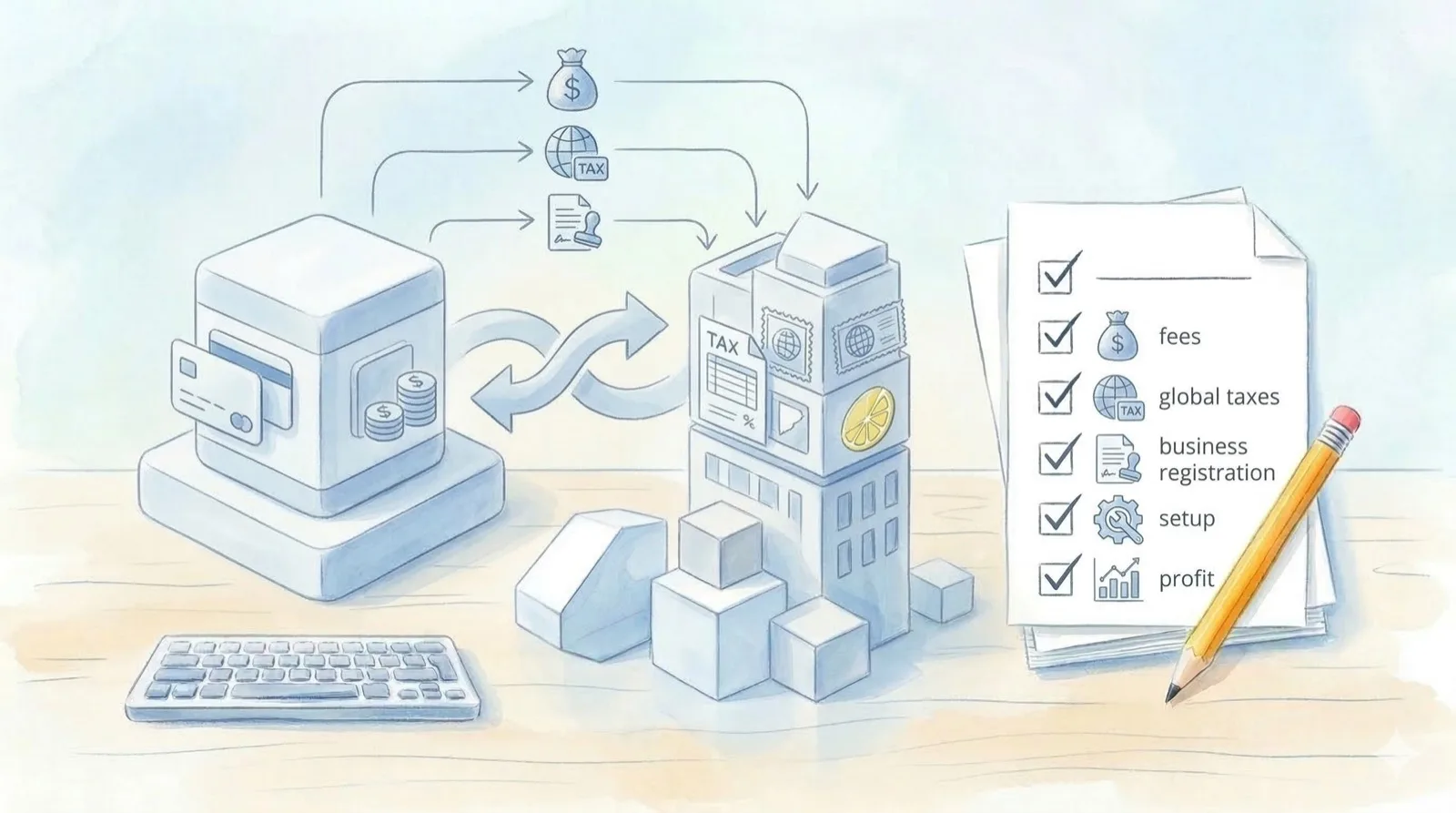
Lemon Squeezy vs Stripe - A Korean Solo SaaS Builder's Comparison
The Real Problem: Taxes, Not Payments
When you’re building a global SaaS as a solo operator in Korea, integrating payments is actually the smallest problem. Whether you pick Stripe or Lemon Squeezy, following the API docs gets you a working checkout. The real problem is tax compliance.
Specifically:
- Sales Tax regulations that differ across all 50 US states
- VAT rates and filing obligations across 27 EU countries
- Separate GST rules in Australia, New Zealand, Canada, and India
- The UK’s post-Brexit VAT regime
- Country-specific rules on digital service taxation (including B2B vs B2C distinctions)
For a solo operator to manage all of this means either hiring a tax consultant or becoming an international tax expert yourself. Neither is realistic.
When choosing a payment service, the more fundamental question is not “what’s the fee percentage?” but who handles the taxes? This post compares Lemon Squeezy and Stripe with that question at the center.
What the MoR (Merchant of Record) Model Is
Definition
MoR is a model where a third party acts as the legal seller on your behalf. When a customer pays, the name on their credit card statement is not your company - it’s the MoR service. Legally, the MoR is the entity that sold the product to the customer, and the MoR then remits settlement funds to you.
Why this matters:
- Tax liability: The MoR calculates and remits VAT/GST for each country. The seller has no tax filing obligations for international sales.
- Refunds/chargebacks: If a customer requests a refund or files a chargeback, the MoR - as the legal seller - handles the dispute.
- Regulatory compliance: Primary obligations for GDPR, PCI DSS, and similar regulations fall on the MoR.
- Invoice issuance: The MoR issues tax invoices to customers. The seller doesn’t need to generate invoices matching each country’s format.
MoR vs Payment Processor: Payment Flow Comparison
flowchart TB
    subgraph MoR["MoR Model (Lemon Squeezy)"]
        direction TB
        C1[Customer] -->|Payment| M1[Lemon Squeezy<br/>Legal Seller]
        M1 -->|VAT/GST Calculation & Remittance| T1[Tax Authorities<br/>Per Country]
        M1 -->|Settlement Payout| S1[Seller<br/>Korean Solo Operator]
        M1 -->|Tax Invoice Issued| C1
    end

    subgraph PP["Payment Processor Model (Stripe)"]
        direction TB
        C2[Customer] -->|Payment| P1[Stripe<br/>Payment Intermediary]
        P1 -->|Revenue Settlement| S2[Seller<br/>Korean Solo Operator]
        S2 -->|Self-managed VAT/GST Calculation & Remittance| T2[Tax Authorities<br/>Per Country]
        S2 -->|Self-issued Tax Invoice| C2
    end
The core difference is clear. In the MoR model, all tax-related arrows route through the MoR. In the Payment Processor model, the seller must handle tax obligations directly between themselves, the tax authorities, and the customer.
What MoR Covers - and What It Doesn’t
What MoR handles:
| Area | Coverage |
|---|---|
| VAT/GST | Automatic calculation, collection, and remittance |
| Sales Tax (US) | Per-state rate application, Nexus determination |
| Tax invoices | Automatically issued to customers |
| Refunds/chargebacks | First-line response |
| Fraud prevention | Basic fraud detection |
| PCI DSS compliance | Card data handling |
What MoR does NOT handle:
| Area | Seller’s Responsibility |
|---|---|
| Korean income tax | Income reporting on MoR settlement funds in Korea |
| Business registration | Korean business registration must be done by the seller |
| Foreign currency income reporting | Reporting foreign-sourced income to Korean tax authorities |
| Product liability | Service quality, SLA, etc. remain the seller’s responsibility |
| Privacy policy | In-product privacy policy and data handling are the seller’s domain |
MoR handles “international tax compliance” on your behalf - it does not eliminate your domestic Korean tax obligations. Korean income tax and VAT filings must still be handled separately.
Lemon Squeezy: Detailed Analysis
Overview
Lemon Squeezy is an MoR-based payment platform launched in 2021. It was acquired by Stripe in 2024 but continues to operate as an independent service. It specializes in digital products and SaaS subscriptions, and is especially popular among indie hackers and small-scale SaaS builders.
Signup Process (Non-US Residents)
The process for a Korean business owner to sign up for Lemon Squeezy is relatively straightforward:
- Create an account with email
- Enter profile information (name, country, address)
- Connect a payout method (Payoneer or PayPal)
- Create a store and register products
- Review and activation within approximately 1-3 business days
No US EIN (tax identification number) or US bank account is required. You can sign up with a Korean passport and Korean address. This is one of the biggest differences from Stripe.
Fee Structure
| Item | Fee |
|---|---|
| Base transaction fee | 5% + 50¢ (per transaction) |
| Subscription payments | Same (5% + 50¢) |
| On refund | Fee is not refunded |
| Monthly fixed cost | None |
| Chargeback fee | $15 (per dispute) |
At first glance, 5% + 50¢ is more expensive than Stripe for payment processing alone. But this rate includes VAT/GST handling, tax invoice issuance, chargeback management, an affiliate program, and subscription management UI - all built in. Replicating the same feature set on Stripe requires additional costs and development time.
Key Features
Subscription management: You can create subscription plans, set pricing, configure free trials, and define upgrade/downgrade policies - all from the dashboard. No need to build a separate admin panel.
Hosted checkout: Lemon Squeezy provides hosted payment pages. You can display them as overlays on your own site or redirect to a separate URL.
License key management: Software license key issuance and validation are built in. Useful for selling desktop apps or plugins.
Affiliate program: A complete affiliate marketing system is available out of the box - affiliate registration, commission rate configuration, tracking, and payouts are all included.
Email marketing: Basic email functionality is included. You can configure customer segment-based emails and post-purchase automated emails from the dashboard.
Pros and Cons
Pros:
- Tax compliance burden essentially disappears
- Subscription management, affiliate programs, and more come bundled as an all-in-one package
- Low barrier to entry for non-US business owners
- Dashboard UI is intuitive and configuration-driven for quick setup
- Post-Stripe acquisition, stability concerns have diminished
Cons:
- Fees are roughly double Stripe’s headline rate
- Payment methods center on cards + PayPal (limited regional payment methods)
- Low customization flexibility (difficult to finely control checkout flows)
- Payouts route through Payoneer, incurring additional FX fees
- API capabilities are more limited compared to Stripe
Stripe: Detailed Analysis
Overview
Stripe is a global payment infrastructure company founded in 2010. Operating as a Payment Processor, it provides payment technology infrastructure, but the legal seller is the merchant (business owner) themselves. It’s the most widely used payment API in the world, renowned for its developer-friendly documentation and SDKs.
Korean Business Signup
Stripe includes Korea in its list of supported countries. You can sign up with a Korean business registration certificate and receive payouts to a Korean bank account. There are a few considerations, however:
- Business registration required: Individual (non-registered) sign-up is not possible. You need either a simplified or standard tax payer business registration.
- Some feature restrictions: Features available to Korean Stripe accounts may be limited compared to US accounts. Stripe Atlas and Stripe Issuing, in particular, are not available in Korea.
- Complexity for global sales: When selling globally as a Korean business, you must handle overseas customer VAT yourself. Adding Stripe Tax enables automatic calculation, but the final filing and remittance responsibility remains with the merchant.
Fee Structure
| Item | Fee |
|---|---|
| Base transaction fee | 2.9% + 30¢ (US card basis) |
| International card surcharge | +1.5% |
| Currency conversion | +1% |
| Stripe Tax | +0.5% (per transaction) |
| Stripe Billing | 0.5-0.8% (subscription management) |
| Chargeback fee | $15 (per dispute) |
| Monthly fixed cost | None (basic) |
| Stripe Radar (fraud prevention) | Basic free, advanced $0.07/transaction |
The key thing to watch is the international card and currency conversion fees. Since a Korean business selling globally will process most payments on international cards, the effective fee rate approaches 2.9% + 1.5% (international) + 1% (currency) + 30¢ = 5.4% + 30¢. Add Stripe Tax and it becomes 5.9% + 30¢.
Stripe appears cheaper in a simple fee comparison, but when selling globally - after combining international card surcharge, currency conversion, and Tax add-on fees - the real gap with Lemon Squeezy’s 5% + 50¢ narrows considerably.
Key Features
API flexibility: Stripe’s greatest strength. You can control nearly every step of the payment flow via API - custom checkouts, Payment Intent-based flows, multi-step payment scenarios, and more.
Stripe Billing: A subscription management module supporting proration, metered billing, coupons, trials, and other advanced subscription scenarios. However, it carries a separate fee (0.5-0.8%), and you must build the admin UI yourself.
Stripe Tax: An automatic tax calculation module. It automatically applies tax rates based on customer location and generates tax invoices. But it does not remit taxes - it only calculates. Filing and remittance remain the merchant’s responsibility.
Diverse payment methods: Beyond cards, Stripe supports ACH, SEPA, iDEAL, Bancontact, Giropay, Alipay, WeChat Pay, and many other regional payment methods. This is advantageous when targeting specific regional markets.
Stripe Connect: A feature for building marketplace or platform businesses. It handles seller onboarding, split payouts, and more. This is more relevant to platform businesses than SaaS.
Pros and Cons
Pros:
- Best-in-class API flexibility and developer documentation
- Extensive payment method support
- Direct settlement to Korean bank accounts (reduced FX fees)
- Massive ecosystem (plugins, libraries, community)
- Enterprise-grade stability and scalability
Cons:
- Tax compliance must be handled by the merchant (Stripe Tax only calculates)
- Korean business registration is mandatory
- Subscription management UI must be built from scratch
- Initial setup requires development time
- At small revenue scales, the infrastructure buildout cost is disproportionate
Core Comparison
Feature-by-Feature Breakdown
| Item | Stripe | Lemon Squeezy |
|---|---|---|
| Model | Payment Processor | MoR (Merchant of Record) |
| Legal seller | The merchant | Lemon Squeezy |
| Korean business signup | Business registration required, some features restricted | Globally accessible signup |
| Automatic tax calculation | Available with Stripe Tax add-on (+0.5%) | Included by default |
| Tax remittance | Not available (merchant handles directly) | MoR handles it |
| Tax invoice issuance | Automatic with Stripe Tax | Included by default |
| Payment methods | Cards, bank transfers, regional methods - very diverse (Apple Pay/Google Pay integration particularly strong → checkout conversion advantage) | Cards + PayPal primarily (Apple Pay/Google Pay supported but relatively weaker) |
| Subscription management | Stripe Billing (powerful, self-built) | Built-in subscription management UI |
| Payout settlement | Direct deposit to Korean bank account | Via Payoneer or PayPal |
| Base fee | 2.9% + 30¢ | 5% + 50¢ |
| Effective global sales fee | ~5.9% + 30¢ (international card + FX + Tax) | 5% + 50¢ |
| Customization | API-driven, maximum flexibility | Configuration-driven, limited flexibility |
| Affiliate program | Must build separately | Built in |
| License keys | Must build separately | Built in |
| Email marketing | Requires external service integration | Built in |
| Checkout page | Self-built or Stripe Checkout | Hosted checkout provided |
| Development difficulty | Medium-High (direct API integration) | Low-Medium (configuration + webhooks) |
| Scalability | Very high | Moderate |
Fee Simulation
Estimating the effective cost for both services at $1,000 monthly revenue (20 transactions, average $50/transaction):
| Item | Stripe (Global Sales) | Lemon Squeezy |
|---|---|---|
| Base fees | $29 + $6 = $35 | $50 + $10 = $60 |
| International card surcharge | +$15 (1.5%) | Included |
| Currency conversion | +$10 (1%) | Included |
| Stripe Tax | +$5 (0.5%) | Included |
| Payoneer FX | N/A | ~$10 (~1%) |
| Total | ~$65 (6.5%) | ~$70 (7%) |
For global sales, the effective fee difference is about 0.5 percentage points. The real decision factor is whether that 0.5% savings justifies building tax compliance, subscription management, and affiliate programs from scratch.
Note: This simulation is a rough estimate. Actual fees vary based on card type, customer country, exchange rates, and other factors.
Tax Handling Comparison
flowchart LR
    subgraph LS["Lemon Squeezy"]
        direction TB
        A1[Customer pays $50] --> B1[LS auto-calculates VAT<br/>e.g., EU customer → +21% VAT]
        B1 --> C1[Customer charged $60.50]
        C1 --> D1[LS remits $10.50 VAT to EU]
        D1 --> E1[Seller receives $50 settlement<br/>minus fees]
    end

    subgraph ST["Stripe + Stripe Tax"]
        direction TB
        A2[Customer pays $50] --> B2[Stripe Tax calculates VAT<br/>e.g., EU customer → +21% VAT]
        B2 --> C2[Customer charged $60.50]
        C2 --> D2[Seller receives $60.50 settlement<br/>minus fees]
        D2 --> E2[Seller must self-remit<br/>$10.50 VAT to EU]
    end
Stripe Tax “calculating” taxes and Lemon Squeezy “remitting” taxes are fundamentally different services. Even with Stripe Tax, the merchant must register with each country’s tax authority and periodically file and remit taxes. For the EU alone, you need to register with the OSS (One-Stop Shop) system, and even that process is complex for non-EU businesses.
Integration Complexity Comparison
flowchart TB
    subgraph LS_INT["Lemon Squeezy Integration"]
        direction TB
        L1[Register Products/Subscriptions<br/>Configure in Dashboard] --> L2[Generate Checkout URL<br/>Single API Call]
        L2 --> L3[Receive Webhooks<br/>Sync Subscription Status]
        L3 --> L4[Done]
    end

    subgraph ST_INT["Stripe Integration"]
        direction TB
        S1[Create Products/Prices<br/>API or Dashboard] --> S2[Create Checkout Session<br/>or Implement Payment Intent]
        S2 --> S3[Receive Webhooks<br/>Handle Multiple Event Types]
        S3 --> S4[Implement Subscription Logic<br/>Upgrade/Downgrade/Cancel]
        S4 --> S5[Build Customer Portal<br/>or Integrate Stripe Portal]
        S5 --> S6[Configure Stripe Tax<br/>Tax Rate Mapping]
        S6 --> S7[Done]
end| Comparison Item | Stripe | Lemon Squeezy |
|---|---|---|
| Checkout implementation | Stripe Checkout (simple) or custom build (complex) | Hosted URL or overlay (simple) |
| Webhook event types | 100+ event types | ~20 event types |
| Subscription state management | Must implement yourself | Managed via dashboard |
| Customer self-service portal | Stripe Customer Portal or custom build | Built-in customer portal |
| SDKs/libraries | Support for nearly every language | JS/Python/PHP primarily |
| Documentation quality | Industry-leading | Good, but less comprehensive than Stripe |
| Estimated initial implementation time | 2-5 days (basic subscription flow) | 0.5-1 day |
Webhook integration is essential for both services. You must receive and process events for successful payments, subscription renewals, cancellations, and more on your server. The basic flow is similar, but Stripe has far more event types to handle and more complex edge case processing.
Considerations for Korean Business Owners
Business Registration Type and Payment Service Choice
There are differences based on business registration type when running a global SaaS from Korea:
| Business Type | Stripe | Lemon Squeezy |
|---|---|---|
| Unregistered (individual) | Cannot sign up | Can sign up |
| Simplified tax payer | Can sign up | Can sign up |
| Standard tax payer | Can sign up | Can sign up |
| Corporation | Can sign up | Can sign up |
If you want to start without business registration in the early stages, Lemon Squeezy is the only option. That said, under Korean tax law, if you generate continuous and recurring income, you’re obligated to register a business, so registration becomes necessary once revenue starts coming in.
Payout Settlement and Foreign Currency Income
Stripe payout route:
Stripe deposits directly to a Korean KRW bank account. Stripe handles the currency conversion, and the conversion fee is included in the transaction fee. Relatively straightforward.
Lemon Squeezy payout route:
Lemon Squeezy settles to Payoneer, which then transfers to a Korean KRW bank account. Payoneer charges an additional conversion fee (approximately 1-2%). Beyond Payoneer’s FX conversion fee, a separate withdrawal fee may also apply depending on the withdrawal method (e.g., bank transfer). The settlement cycle may also be longer compared to Stripe.
In both cases, you have a foreign currency income reporting obligation to the Korean tax office. Overseas revenue must be included when filing comprehensive income tax, and you may be eligible for tax credits on foreign-sourced income.
Korean VAT Considerations
When a Korean business provides digital services to overseas customers, Korean VAT is applied at the zero rate (0%). This means you don’t need to collect Korean VAT on overseas revenue. However, to qualify for the zero rate, you must have export documentation (payment records, customer location verification, etc.).
This applies equally regardless of whether you use Stripe or Lemon Squeezy - it’s a Korean tax law requirement.
Foreign Exchange Transaction Reporting
If annual foreign currency income exceeds a certain threshold, you may need to file a foreign exchange transaction report with the Bank of Korea. This is also a Korean business owner’s obligation regardless of payment service.
Whether your payment service is an MoR or Payment Processor, Korean tax obligations (income tax, zero-rated VAT filing, foreign exchange reporting) apply identically. What MoR resolves is each foreign country’s tax - not Korean domestic taxes.
Decision Framework
Decision Tree
flowchart TD
    A[Choosing a Payment Service<br/>for Global SaaS] --> B{Do you have<br/>business registration?}
    B -->|No| C[Lemon Squeezy<br/>Can start without registration]
    B -->|Yes| D{Do you have sufficient<br/>engineering resources?}
    D -->|No| E[Lemon Squeezy<br/>Fast setup, all-in-one]
    D -->|Yes| F{Is monthly revenue<br/>above $5,000?}
    F -->|No| G[Lemon Squeezy<br/>Better ROI vs infra build cost]
    F -->|Yes| H{Do you need regional<br/>payment methods?}
    H -->|Yes| I[Stripe<br/>Diverse payment method support]
    H -->|No| J{Do you need fine-grained<br/>checkout flow control?}
    J -->|Yes| K[Stripe<br/>Maximum API flexibility]
    J -->|No| L[Either works<br/>Decide on fees vs convenience]
When Lemon Squeezy Is the Better Choice
- Solo or small-team early-stage SaaS
- You don’t want to spend time on tax compliance
- Pre-registration MVP validation stage
- You need affiliate programs or license key management
- Monthly revenue under $5,000, where the fee difference is small in absolute terms
When Stripe Is the Better Choice
- Services focused primarily on the Korean domestic market
- You have engineering resources and want direct control over the payment flow
- Revenue scale is large enough that fee differences become material (above $10,000/month)
- Regional payment methods like iDEAL, SEPA, or Alipay are essential
- You’re building a marketplace or platform business
- You already have Stripe-based infrastructure in place
Other Alternatives
Lemon Squeezy and Stripe aren’t the only options. Here’s a brief overview of other choices.
| Service | Model | Fees | Characteristics | Korean Business |
|---|---|---|---|---|
| Paddle | MoR | 5% + 50¢ | Similar to Lemon Squeezy, stronger for B2B SaaS | Can sign up |
| Gumroad | MoR | 10% | Specialized in digital product sales, high fees | Can sign up |
| FastSpring | MoR | Negotiated | Enterprise SaaS and gaming industry | Can sign up |
| PayPal | Payment Processor | 4.4% + 30¢ (international) | General-purpose payments, limited subscription features | Can sign up |
Paddle is the most direct competitor to Lemon Squeezy. It uses the MoR model with a similar fee structure. It’s more specialized for B2B SaaS, and if you need enterprise customer handling (quotes, PO-based payments, etc.), Paddle may be a better fit.
Gumroad specializes in digital product sales (ebooks, templates, courses, etc.). It’s better suited for one-time digital product sales than SaaS subscriptions, and its 10% fee is on the high side.
FastSpring is primarily used by enterprise software companies and game studios. It works on a custom-negotiated basis, making it unsuitable for small-scale SaaS.
Practical Checklist
A checklist for Korean solo operators choosing a payment service.
Before deciding:
- Do you currently have business registration?
- Is your target market global or domestic?
- What is your estimated monthly revenue?
- How much development time can you allocate to payment integration?
- Is it a subscription model or one-time sales?
- Do you need affiliate programs or license key management?
- Are specific regional payment methods (iDEAL, SEPA, etc.) essential?
After choosing (common tasks):
- Korean business registration (if not registered)
- Open a foreign currency account or Payoneer account
- Implement and test webhook endpoint
- Implement subscription status sync logic
- Confirm overseas revenue is included in comprehensive income tax filing
- Prepare zero-rated VAT documentation for exports
Conclusion
For a solo operator in the early stages, the selection criterion is what can I avoid doing? Lemon Squeezy’s MoR model takes the entire burden of global tax compliance off your plate. Its fees are higher than Stripe’s headline rate, but the effective cost gap for global sales is smaller than you’d expect. When you factor in the time cost of building tax compliance and subscription management yourself, it can actually be more economical in the early stages.
Once monthly revenue exceeds $10,000, or you need fine-grained control over your checkout flow, or regional payment methods start materially affecting conversion rates - that’s when you evaluate a Stripe migration. It’s not too late. Switching payment services is inconvenient, but it’s not impossible.
The most important thing is to spend those two weeks building your product instead of agonizing over payment systems.
Frequently Asked Questions
Can you use Stripe in Korea?
Yes. A Korean business registration can open a Stripe account and settle to a Korean bank account, and since late 2024 KRW payments and local methods like Naver Pay, Kakao Pay, and Samsung Pay are officially supported. Some features (Stripe Atlas, Stripe Issuing) remain unavailable on Korean accounts.
Which is better for a Korean solo SaaS founder - Lemon Squeezy or Stripe?
For most solo founders, Lemon Squeezy is the simpler default because it acts as Merchant of Record, handling global VAT and sales tax automatically. Stripe gives you payment rails only - taxes become your responsibility, and that's the expensive part for a one-person operation.
What is a Merchant of Record (MoR)?
A Merchant of Record is the legal seller in a transaction, taking on VAT and sales tax filings plus refund and chargeback liability. In exchange for a higher fee, the seller is freed from filing in 50 US states, 27 EU countries, and other tax jurisdictions.
What are Lemon Squeezy's fees?
Lemon Squeezy charges 5% + $0.50 per transaction, higher than Stripe's 2.9% + $0.30. The premium pays for global tax handling, refund management, and compliance - at some revenue threshold, Stripe plus a tax automation tool (TaxJar, Quaderno) becomes cheaper.
How do Korean SaaS founders handle global taxes?
Three paths: (1) MoR providers like Lemon Squeezy or Paddle to delegate fully; (2) Stripe combined with tax automation SaaS (TaxJar, Quaderno); (3) Incorporate a US LLC via Stripe Atlas and file globally yourself. For solo operators, MoR is usually the most time-efficient choice.
Related Posts

Six GEO Business Opportunities and WICHI's Choice
Strategic analysis of three opportunity factors in the AI search (GEO) market and why WICHI chose 'SaaS-based monitoring' over advertising or agency models.

Prototype to Production - The Complete Change List
10 key changes for transitioning an MVP to commercial SaaS: security hardening, JWT auth, KO/EN i18n, and payment automation to build a 'payment-ready' service.

Jocoding Hackathon Build Log - Building a GEO SaaS in 3 Days
Recording the 3-day MVP build for WICHI during the Jocoding Hackathon, covering tech stack choices (FastAPI, React, Supabase) and priorities for creating a 'working product' under tight deadlines.