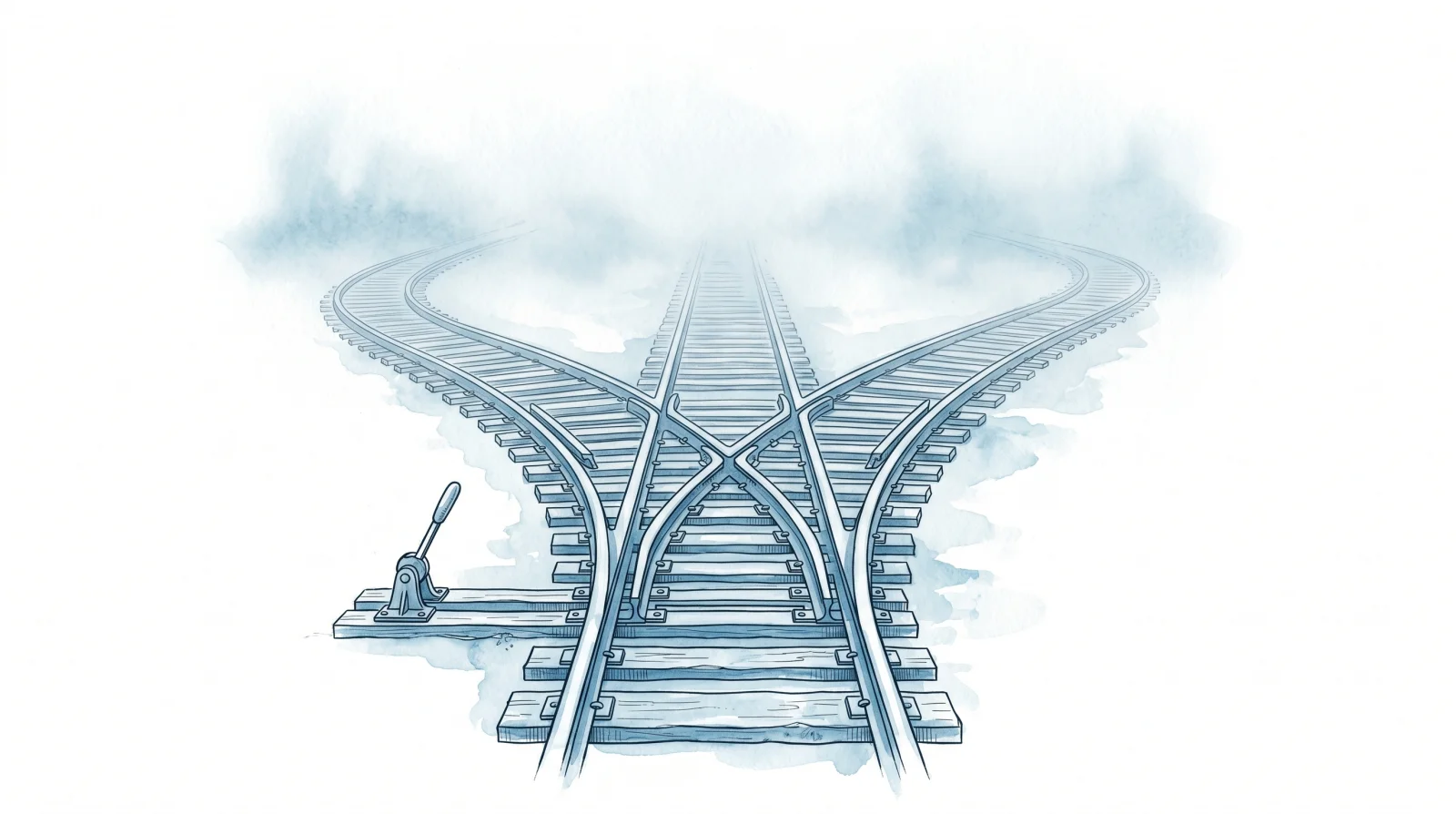
Will AI Free or Cement Korea - Deregulation × AI Build × SI Inertia
Is Korea Trapped, or a Leading Indicator?
In Part 2 we saw the cost Korea’s build trap creates - foreign SaaS blocked, Korean SaaS detouring through Japan, both faces of the same mechanism. This article adds the variable of the AI era on top.
The question is simple. Will AI free Korea’s build trap, or cement it? The answer isn’t simple - there’s no single force pulling in one direction. Three forces are simultaneously moving, and their strength and collision determine Korea’s software market over the next 5 years.
This article splits in two parts.
⓵ Part 1 - 3 Forces: What they are and how they operate ⓶ Part 2 - 3 Scenarios: How those forces combine to take the market somewhere
First the forces, then the scenarios.
Part 1 - 3 Forces
The three forces hit Korea’s market from different sources at different speeds. One-line summary:
| Force | Direction | One-liner |
|---|---|---|
| A. Deregulation | Korea → accepting global SaaS | The market is opening, late |
| B. AI Build Resurgence | Global → returning to build | Global is moving back to build |
| C. SI Inertia | Resistance | The momentum of 30 years of revenue and headcount |
The three operate simultaneously but differ in strength and timing.
Force A - Deregulation (Korea → Accepting Global SaaS)
Entry barriers like CSAP and network separation are slowly weakening. Key signals:
- CSAP grading system implemented (2023~2024): Public cloud security certification was subdivided into top/mid/low grades by system criticality. Low-grade implementation came first, enabling partial entry of foreign SaaS.
- CSAP further reform (2026 in progress): Government is pursuing the removal of CSAP from public mandatory requirements, transition to voluntary private certification, and abolition of the grading system. Public cloud security policy is being moved to NIS (National Intelligence Service).
- Network separation gradual easing discussion: Especially in finance, discussions on expanding cloud usage scope are in progress.
- Digital Platform Government SaaS-first procurement: Policy direction prioritizing SaaS purchases in the public sector.
- K-PaaS activation: Open-source PaaS infrastructure (formerly PaaS-TA) led by Ministry of Science and ICT + NIA.
Direction is consistent - carving out space for buy on top of the build market.
Why So Slow
Changing regulation alone doesn’t open a market instantly. Korea’s cloud regulation is a byproduct of the build market (see Part 1). Even when policy changes, if commissioning pricing model and SI industry structure don’t change in parallel, effects are limited. Even Digital Platform Government’s SaaS-first procurement faces real procurement officials defaulting to “the existing SI model is more familiar.”
Change Signals Despite That
- Foreign clouds (AWS, Azure, GCP) expanding Korea regions + data sovereignty guidelines emerging
- Some financial sector SaaS adoption cases (HR, collaboration leading)
- Public sector SaaS-first procurement mandatory ratio expanding
The Timing Trap
Deregulation accelerates at the same time as Force B (AI Build Resurgence). If global SaaS itself is slowing growth at the moment Korea’s market opens, the priority of foreign SaaS entering Korea drops. The market opens, but fewer players want to enter - that’s the structure.
Deregulation opens the SaaS market, late. But the timing overlaps with AI Build Resurgence.
Force B - AI Build Resurgence (Global → Returning to Build)
At the same time, global is returning from SaaS to build. Key signals:
- Cursor, Claude Code, v0: Tools that drastically dropped the cost of in-house engineers building directly
- “SaaS is dead” discourse: a16z, Bessemer, and others publishing pieces arguing vertical agents replace horizontal SaaS
- In-house sLLMs · agentic workflows: Small models trained on internal data replacing parts of SaaS functionality
- Large enterprise LLM internalization (Korea): Samsung Gauss (since 2023.11, with Gauss 2 follow-up), LG EXAONE 3.0 (2024.8) → 3.5 + ChatEXAONE for employees, SK C&C Solur LLMOps - an LLMOps platform released by SI vendor SK C&C, which trains and operates external LLMs (GPT, HyperCLOVA X, Gemini) on enterprise data to produce sLLMs
What Changed
Build cost dropped sharply. Five years ago, building one in-house system took dozens of engineers and a 6-12 month project. Today, a small team using Cursor or Claude Code produces the same result in 1-2 months. The equation that justified SaaS subscriptions - “build is more expensive than buy” - has broken in some areas. Especially in vertical domains (sales, customer support, internal operations), in-house build now produces forms more closely fit to the company’s processes faster than SaaS.
Why Ambivalent for Korea
This force is precisely ambivalent for Korea.
⓵ Retroactive justification side: Korea’s preserved build mindset suddenly looks aligned with the global trend. The reading “Korea was right to be conservative” becomes possible. ⓶ Mechanism collision side: Korea’s build = SI outsourcing, AI build = in-house engineering. Same word, different game. Just because Korea stayed in build doesn’t mean it automatically enters AI build (the core distinction in Series Part 0).
Direction converges toward Korea. Whether the method is one Korea is familiar with is a separate question.
Force C - SI Inertia (Resistance to Change)
Korea’s SI industry has 30 years of accumulated revenue and headcount structure. How that inertia operates when AI Build Resurgence arrives in Korea is decisive.
Two Possible Evolution Paths for SI
⓵ AI-augmented SI (inertia preserved): SI Big 3 internalize AI tools, keeping the N people · M months model but reducing N and M. Revenue is preserved by raising per-headcount pricing. Effectively the scenario where SI survives the AI era. From the buyer’s perspective, the SI commissioning model stays unchanged - SI just builds faster using AI.
⓶ SI Bypass (inertia weakening): Conglomerate and financial in-house engineering teams strengthen, SI commissioning shrinks. SI Big 3 revenue stagnates. AI build is processed in-house.
Which Way Are Signals Pointing So Far
So far signals lean toward ① AI-augmented.
- SI Big 3 revenue is on the growth side rather than stagnation (especially group SI is stable)
- “AI-leveraged SI” is rapidly forming as a category (SK C&C Solur LLMOps - an SI productizing its own LLMOps platform, Samsung SDS in-house LLM, etc.)
- That said, ② SI Bypass is also progressing in some areas - tech conglomerates, fintech, some globally-oriented firms
The Crux
Which moves faster decides the scenario. If SI’s AI-augmented evolution outpaces in-house engineering team growth, SI is preserved. If in-house engineering grows faster, SI dependency decreases. Both shifts happen simultaneously, but the speed difference shapes the market.
Commissioning Cycle vs. Technology Change Cycle
Force C’s real difficulty is the time structure of the SI model itself. Compare cycle lengths:
| Cycle | Time unit |
|---|---|
| Technology change (model · tool releases) | Quarterly (3-6 months) |
| AI Build (in-house engineer + AI collaboration) | Days to weeks |
| SI commissioning · build (RFP → build → acceptance) | 6-24 months |
The asymmetry is clear. At the moment SI commissioning’s deliverable is finished, it’s often already outdated. The spec set into the RFP six months earlier has become a level a generation or two behind the latest models and tools. This isn’t an SI capability problem - it’s a time-structure problem of the model itself.
When this accumulates, two effects emerge:
⓵ Technical debt accumulation - Systems built to the spec at commissioning time get overrun by tech change before they even settle in. Next commissions either stack new systems on top, or rebuild from scratch. Each commissioning piles up debt, and debt clearance is again RFP - an infinite loop. ⓶ Self-reinforcement of “no success cases” - RFPs demand “verified cases,” but AI is by nature an area where verified cases are scarce. Korean enterprise AX’s lack of sharp success cases reinforces the conservatism of the next commissioning. In a multi-layer approval structure, decisions without reference are nearly impossible.
Whether SI’s AI-augmented evolution can narrow this asymmetry is Force C’s real test. Internalizing tools doesn’t shorten the commissioning cycle itself - the commissioner’s decision cycle, RFP authoring cycle, and acceptance cycle remain long.
Part 2 - 3 Scenarios
How do the three forces combine to produce scenarios? Forces are inputs, scenarios are outputs.
Force × Scenario Mapping
The combination of how each of the three forces operates determines the scenario. Rows are scenarios, columns are forces.
| Scenario | A. Deregulation | B. AI Build Resurgence | C. SI Inertia | Result one-liner |
|---|---|---|---|---|
| ① Korea Vindicated | Late | Fast | Natural evolution (AI-augmented SI dominant) | SI evolves into AI build, Korean market converges with global |
| ② Double Loss | Fast | Fast | Stagnant (SI outsourcing as-is) | Neither SaaS nor AI build grows in Korea, only SI is preserved |
| ③ Bifurcation | Fast | Fast | Partial evolution (some in-house build) | Top splits, bottom stays in SI - two markets diverge |
All three scenarios assume Force B (AI Build Resurgence) arrives quickly. The differences are how fast Force A (Deregulation) opens and how Force C (SI Inertia) shifts.
Scenario ① - Korea Vindicated
Mechanism: A (Deregulation) opens late, but B (AI Build Resurgence) arrives faster, weakening SaaS globally. C (SI Inertia) naturally evolves into AI build.
Picture in 3 years:
- Korea = a leading indicator of the global return to build
- SI industry secures a new position with AI engines (“AI-augmented SI”)
- Korean SaaS detour through Japan diminishes (Korean market also converges to U.S./Japan-style build mindset)
- Korean build model becomes exportable to other Asian markets
Leading Indicators (signals pointing this way):
- SI Big 3 announce in-house AI engines / sLLM-based build automation
- “AI-augmented SI” becomes a standard industry category
- Korean SaaS detour-to-Japan share decreases (direct sales in Korea become possible)
- Foreign SaaS entry priority in Korea drops
Who wins, who loses:
- Wins: SI Big 3 (the ones with AI engines), Korean sLLM companies, conglomerates strengthening in-house engineering
- Loses: Korea GTM teams of global SaaS, some Korean-headquartered SaaS companies
Necessary conditions: SI converts from pure headcount input to AI-engine ownership model. Whether SI Big 3 can lead this is the crux.
Scenario ② - Double Loss
Mechanism: A opens, but B kills SaaS itself, and C stays in SI outsourcing without growing in-house build capacity.
Picture in 3 years:
- Foreign SaaS, by the time Korea’s market opens, is already weakened - entry value drops
- Korean SaaS gets squeezed between global trends and Korea’s build inertia, shrinking
- SI survives on the outsourced-build model but doesn’t evolve into AI-era in-house build
- SI alone stays in a stable structure
Leading Indicators:
- No signal of in-house engineer hiring increases (across conglomerates and finance)
- Even with SaaS-first procurement policy, actual commissioning regresses to SI outsourcing
- Korean SaaS overseas revenue dependence deepens further (Japan/SF detour intensifies)
- Global SaaS Korea offices contract or withdraw
Who wins, who loses:
- Wins: Existing SI Big 3 (preserved by inertia)
- Loses: Korean SaaS companies (especially those keeping HQ in Korea), global SaaS, diversity of Korean IT jobs
Necessary conditions: Conglomerate and financial in-house engineering stays stagnant. In-house engineer hiring is constrained. SI’s AI evolution is also superficial (announces tool adoption but real build model unchanged).
Self-reinforcement of technical debt (the hidden mechanism of this scenario):
This scenario is most dangerous because it looks stable on the surface. SI revenue is maintained, commissions keep flowing, approval lines run unchanged. But underneath:
- Each system built to the commissioning spec is already outdated by completion → technical debt accumulates
- New commissions to clear debt are again RFP → debt accumulates again
- Korean enterprise AX’s sharp success cases don’t accumulate → reference absence → commissioning conservatism strengthens → safer RFP models adopted again
- SI has stable revenue, no incentive to change. The buyer has distributed responsibility across approval layers and no one pushes for change.
The result is a market that can’t move to buy and can’t move to AI-era in-house build, while SI’s 30-year model gradually ages. This is why Double Loss isn’t simple “missed opportunity” but structural cumulative loss.
Scenario ③ - Bifurcation
Mechanism: Some conglomerates and financial firms strengthen in-house engineering and evolve into AI build. Mid-market and smaller firms stay in SI outsourcing.
Picture in 3 years:
- Korean market splits into two species (Tier 1 vs. Tier 2)
- Top (tech conglomerates, fintech, some financial bigs): enter U.S.-style in-house build
- Bottom (traditional conglomerates, mid-and-small): stay in SI outsourcing · on-prem
- Limited human and capital movement between the two markets
- SaaS entry is partial, concentrated in the top market
Leading Indicators:
- Tech conglomerate / fintech in-house engineer hiring accelerates (already happening)
- Within the same industry, gaps between firms widen (e.g., big vs. small in finance)
- SaaS adoption rates concentrate in the top market
- SI revenue stays stable in mid-and-small markets
Who wins, who loses:
- Wins: Top group strengthening in-house engineering quickly, AI build tool companies
- Loses: Global SaaS trying to enter both markets (single GTM hard), Korean SaaS dependent on mid-and-small markets
Necessary conditions: In-house engineer hiring accelerates in some conglomerates and financial firms while SI model stays in mid-and-small markets.
Which Scenario Is Most Likely?
It’s hard to call. The market has multiple forces operating simultaneously, and policy, global shocks, and tech jumps introduce contingencies.
That said, some currently observable signals point toward ③ Bifurcation: tech conglomerate and fintech in-house engineering teams are already expanding, and SI dependency reduction is observed in parallel; meanwhile mid-market and smaller firms take longer to adopt AI tools, and the SI model is likely to persist there. The market splitting into two species rather than converging in one direction looks like the natural evolutionary path at this point.
But this is just one possibility. Signals toward ② Double Loss are not few - SI revenue still grows, in-house engineer hiring acceleration is limited to some sectors, and RFP cycles can’t keep up with the speed of change. Possibility of ① Korea Vindicated also stays alive, depending on how fast SI absorbs AI.
Rather than pinning a scenario, reading which signals point in which direction is more valuable. That’s why this series provides a signal table instead of a conclusion.
The Real Branching Point
In all three scenarios the core variable is the same. Whether Korean enterprise in-house engineering teams can build directly using AI tools.
%%{init: {'look': 'handDrawn', 'theme': 'neutral'}}%%
flowchart TD
    A[Now: Korea trapped in build<br/>SI outsourcing, sparse in-house engineering] --> B{In-house engineering<br/>strengthening?}
    B -->|Yes, broadly| C[Scenario 1<br/>Korea Vindicated]
    B -->|Yes, partially| D[Scenario 3<br/>Bifurcation]
    B -->|No| E[Scenario 2<br/>Double Loss]
    style A fill:#fef3c7,stroke:#d4a373
    style B fill:#e8d8c4,stroke:#b89968
    style C fill:#d1f0c5,stroke:#7a9e7e
    style D fill:#ffd6a5,stroke:#c98a5a
    style E fill:#e5d9c8,stroke:#a08d7a
Five signals to watch at this branching point:
| Signal | Meaning | Current state |
|---|---|---|
| Conglomerate in-house engineer hiring share | Build capacity internalization | Partial (tech, fintech), not broad |
| SI Big 3 revenue stagnation or decline | Outsourcing dependence weakening | Not observed (still growing) |
| In-house sLLM · agentic self-build | AI build entry | Many announcements, real operations being verified |
| Cloud SaaS settling (by CSAP grade) | Buy market formation | Partial entry, acceleration signal weak |
| Government SW pricing model change | Commissioning structure shift | Not in motion |
Each signal is a weak signal pointing at a scenario direction. This series doesn’t draw a conclusion - it offers a way to read signals.
Closing Note - What the Series Tried to Test
The series reduced the five peculiarities of Korea’s software market to one root cause. SI dominance, CSAP, local LLMs, multi-layer approval, Korean tokenization are five shadows of build lock-in. That build is the cumulative product of 30 years of public SW pricing, IT outsourcing, and self-build culture. The cost manifests on both sides - Korean SaaS detouring to Japan and foreign SaaS being blocked from entering.
The AI era is an ambivalent variable. On one side, global returning to build retroactively justifies Korea’s build mindset. On the other, Korea’s build mechanism (SI outsourcing) differs from the AI era’s build mechanism (in-house engineering + AI), and that gap creates a jump cost.
The diagnosis “Korea is trapped in build” is only half right. The real question is whether the jump is possible.
This series doesn’t decide. No one knows exactly where the market goes - between the signals at writing time and outcomes 5 years later, too many contingencies, policy variables, and global shocks intrude. Pieces that decide tend to look wrong 5 years later.
If the series holds one stance, it’s about which data to watch. Whether in-house engineering teams strengthen, whether SI cycles shorten, whether RFPs catch up to the speed of change, whether Korean enterprise AX accumulates sharp success cases - these signals point at the market’s actual direction more accurately than other macro indicators.
The 3 Scenarios are different futures but all depend on the same variable. How that variable moves decides whether Korea will be trapped, a leading indicator, or split into two markets. Whichever realizes - or all three partially realize - the series’ real question stays the same: whether Korea can jump from SI-outsourced build to engineering-team build.
The market answers. The series leaves a list of signals to recognize that answer.
Sources
- How is the CSAP grading system changing - IaaS certification recognized at mid-grade (ZDNet Korea, 2023, Korean)
- CSAP grading system enters full operation - top-grade certification strengthened (ZDNet Korea, 2024, Korean)
- CSAP grading system abolished - public cloud security policy moves to NIS unified verification (Edaily, 2026, Korean)
- Government secures legal basis for cloud security - CSAP grading not yet defeated (TechM, Korean)
- CSAP reform trends (Korea Public Finance Information Service, Korean)
- Samsung Gauss - overview (NamuWiki, Korean) - released 2023.11, Gauss 2 follow-up
- Samsung doesn’t stop AI internalization - also develops image generation model (THE ELEC, Korean)
- LG ‘EXAONE 3.5’ - lightweight on-device sLM (LG official press, Korean)
- SK C&C - Solur LLMOps for custom sLLM enterprise self-training and operation (THE ELEC, Korean)
- Open Cloud Platform K-PaaS scalability confirmation - Kakao Enterprise press (Korean)
- Open Cloud Platform PaaS-TA trends and ecosystem activation (SPRi, Korean)
- National Information Society Agency (NIA) - Digital Platform Government Division (Korean)
- Global SaaS Marketplace Support Program - NIPA (Korean)
Back to Series Part 0: Why Korea Doesn’t Buy Software
Series Index: Korea Build Trap
Related Posts

The Cost of Being Trapped - How LINE WORKS, Younglimwon, and RSUPPORT Detour Through Japan
Korean SaaS companies blocked by SI and on-prem walls at home, then taking #1 positions in Japan - a natural experiment in Korea's build lock-in.

How We Got Trapped - Government SW Pricing, Hancom, and 30 Years of SI Outsourcing
How public SW pricing, Hancom/groupware NIH, and 30 years of SI outsourcing produced Korea's build lock-in.
Why Korea Doesn't Buy Software - A Build/Buy/Assemble Reframe of Korea's AI B2B Market
Korea's software spending sits at 0.3% of GDP (rank 51) vs. R&D at 5.0% (rank 1). The series thesis reduces five 'peculiarities' of Korea's market to one root cause.